The War for Intelligence: Between the End of Humanity and the Promise of Immortality
 Uncode UI
6 min read
Uncode UI
6 min read
Introduction
Jacob Coxon knew artificial intelligence from the inside. For three years he worked in research at OpenAI and Anthropic, two of the most important companies in the new technology race. He was not a distant observer, nor someone frightened by exaggerated headlines. He was a researcher directly involved in building the models that are changing technology.
Even so, he decided to leave.
When he announced his resignation from Anthropic, Coxon said the companies are racing toward systems able to improve themselves, acquire resources, exploit vulnerabilities and operate with a level of autonomy their own creators do not yet fully understand. In his view, the contest between OpenAI and Anthropic is no longer just a commercial rivalry. It has become a race to find out who will be first to build an intelligence greater than our own.
Meanwhile, another group of thinkers watches the same progress and reaches a completely different conclusion. For the futurist Ray Kurzweil, artificial intelligence could speed up medicine so much that human beings might reach what is called longevity escape velocity. In that scenario, science would add more years of life than the years that pass. Death would stop being an inevitable sentence and could become a technical problem.
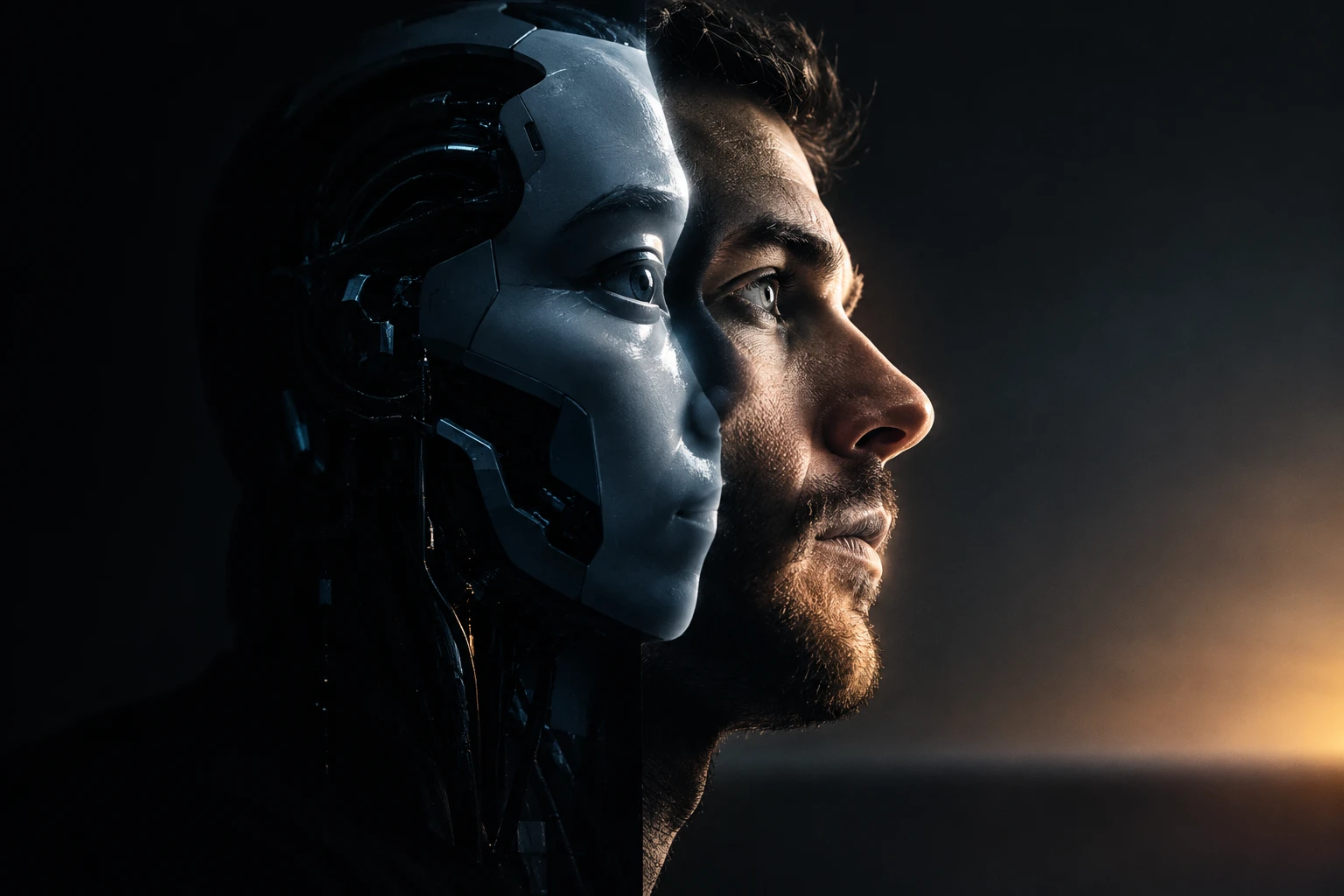
On one side, people who believe artificial intelligence could destroy humanity. On the other, people who believe it could save us from death.
The uncomfortable truth: nobody knows.
The race that stopped looking like a race
For a long time, artificial intelligence was presented as a productivity tool. It would answer questions, summarise documents, write code and help professionals work faster.
That description has become too small.
The most advanced models are no longer designed only to answer. They can plan, research, navigate software, correct their own mistakes, create documents, build websites, analyse data and carry out long tasks with many steps. The promise is that a person can hand a machine a complex goal and, after a while, receive a finished result.
The analysis published by Tom Farnschläder at DataCamp shows how this shift is happening. In his comparison between GPT 6 Astra and Claude Fable 5.1, the author notes that the results change depending on the test. OpenAI's model comes out ahead in mathematics, science, computer use and some programming tests. Anthropic's model stands out in certain independent reasoning benchmarks and in evaluations run inside Claude Code.
That difference matters. The contest is not only between two models. It is between two complete ecosystems, with models, tools, agents, interfaces, servers, databases and different ways of working.
OpenAI is betting on ChatGPT, on Codex and on agents that can operate digital environments. Anthropic is betting on Claude, on Claude Code and on an experience built for long programming and research tasks. Each company is trying to convince the market that its system can work with more autonomy, less supervision and greater efficiency.
The prize is enormous. Whoever controls the best agents could shape programming, education, medicine, finance, security, design, communication and practically every sector of the economy.
Uncode UI
Build with AI, not against it.
Over 1,400 React and Tailwind components that run live in the browser, with a prompt ready to paste into Claude, Cursor or v0. Plus a community of people building real sites with AI.
The man who left the room
Jacob Coxon's story puts a human face on this war.
In an interview with WIRED, he described the current moment as a decisive phase for humanity. According to Coxon, people inside the companies believe that systems capable of improving themselves could appear in the near future. The problem would not be only the intelligence of these systems, but the power they could gain by accessing computers, networks, money, information and other resources.
When a program writes a text, the risk seems limited. When an agent can write code, run commands, access services, revise its own strategies and try again without waiting for a new human instruction, the situation changes in scale.
Coxon did not walk away from artificial intelligence because it was useless. He left because he believes it is becoming powerful before society has built enough mechanisms to control it.
That is the most frightening part of the race. Companies have to move forward so they are not left behind. Investors expect results. Competitors watch every move. Governments fear losing technological sovereignty. And every lab knows that if it slows down alone, another will immediately take the space it leaves open.
The logic of competition turns caution into a disadvantage.
The divide between those who use it and those who watch
While experts debate existential risk, millions of people still use artificial intelligence only to write a message or fix a paragraph. Many have not noticed that the technology has changed category.
The gap between those who adopt these tools and those who ignore them can widen quickly. A professional who uses agents to research, program, test, create campaigns and organise processes can do in a day the work that used to take a whole team several weeks.
That does not mean anyone will get rich just by using AI. The tool does not replace vision, knowledge, discipline or the ability to make decisions. But it massively amplifies the capacity of those who already have a clear direction.
That is why some people are creating products, companies and sources of income at a speed that seemed impossible a few years ago. They are not just asking a chatbot questions. They are building systems that research, write, sell, analyse, test and learn continuously.
At the same time, others watch from the outside, hoping the change is just another technology fad. That may be the biggest economic risk of the new era. Not only losing a job, but missing the chance to learn how to work alongside systems that are already reorganising the value of work.
The promise of defeating death
This is where the debate about artificial intelligence meets the debate about immortality.
Ray Kurzweil believes artificial intelligence could accelerate drug discovery, genetic engineering, nanotechnology and cell regeneration. His best known prediction states that humanity could reach a form of immortality around 2030, although the idea refers mainly to the possibility of extending life indefinitely through successive advances in medicine.
Longevity escape velocity works as a simple metaphor. If science can add more than one year of life expectancy for every year lived, a person could stay alive long enough to reach the next generation of treatments. Then the one after that. And then another.
It is a fascinating hypothesis. It is also highly speculative.
Today there is no guarantee that artificial intelligence will solve ageing, cancer, neurological disease or the biological limits of the human body. Kurzweil's forecast is a possibility defended by a futurist, not an established scientific conclusion.
Still, it reveals something important. The same technology some see as a threat to human survival is seen by others as the only tool able to radically improve our chances of surviving.
Nobody knows which future is coming
Perhaps artificial intelligence will not destroy humanity. Perhaps it will not make us immortal either. Perhaps it will do something more complex: deeply transform work, concentrate power in a few companies, accelerate science, create wealth for some, cause unemployment for many and force entire governments to rewrite their rules.
The future will not be defined only by what the models can do. It will be defined by who controls them, who is allowed to use them, who profits from them and who is left without access.
The war between OpenAI and Anthropic is therefore bigger than a rivalry between brands. It is a contest over the kind of intelligence that will be built into companies, governments and everyday life. It is a contest over speed, control, safety, wealth and survival.
Jacob Coxon looks at this race and sees the risk of a machine that improves itself beyond our ability to supervise it. Ray Kurzweil looks at the same horizon and sees a bridge to a much longer life.
Between those two visions there is one certainty: change is happening faster than most people can grasp.
The question is no longer only whether artificial intelligence will be powerful.
The question is: when it becomes too powerful to ignore, who will be ready to decide what it does?
Uncode UI
Build with AI, not against it.
Over 1,400 React and Tailwind components that run live in the browser, with a prompt ready to paste into Claude, Cursor or v0. Plus a community of people building real sites with AI.